
Turkey Tourist Attractions Map.Turkey tourist attractions map- map of tourist attractions in Istanbul turkey- what is the most beautiful place in Turkey.Turkey (Turkish: Türkiye) may be a bi-continental country: while geographically most of the country is situated in Asia, Eastern Thrace is a component of Europe and lots of Turks have a way of European identity.
Turkey, a country steeped in rich history and culture, boasts an array of tourist attractions that captivate millions of visitors every year. Whether you’re drawn to the ancient ruins, stunning beaches, or bustling cities, Turkey offers something for everyone. In this guide, we will take a detailed journey through the top Turkey tourist attractions, exploring each site’s unique charm and significance. Additionally, we’ll highlight useful tips, maps, and recommendations for making the most of your Turkish adventure.
Discover the Best Turkey Tourist Attractions Map: A Comprehensive Guide


Istanbul Tourist Map Attraction Sightseeing Pdf 2019 Istanbul Clues
The Allure of Turkey’s Tourist Attractions
Turkey is a country that seamlessly blends the ancient and the modern, offering travelers an unparalleled experience. With a mix of historical landmarks, natural wonders, and contemporary vibes, it’s no wonder that Turkey continues to be a top destination for international tourists. Whether you’re a history enthusiast, nature lover, or someone seeking a relaxing beach holiday, Turkey has it all.
A Rich Cultural Heritage
Turkey’s culture is a fusion of Eastern and Western influences, shaped by various empires and civilizations that once ruled the region. From the ancient Greeks and Romans to the Byzantine and Ottoman empires, each historical period has left its mark on the country’s architecture, cuisine, and traditions.
Stunning Natural Landscapes
From the sun-drenched Mediterranean and Aegean coastlines to the unique rock formations of Cappadocia, Turkey’s natural beauty is as diverse as its culture. The country is home to breathtaking landscapes, from towering mountains to serene lakes, making it a perfect destination for outdoor enthusiasts and nature lovers.
Top Turkey Tourist Attractions on the Map
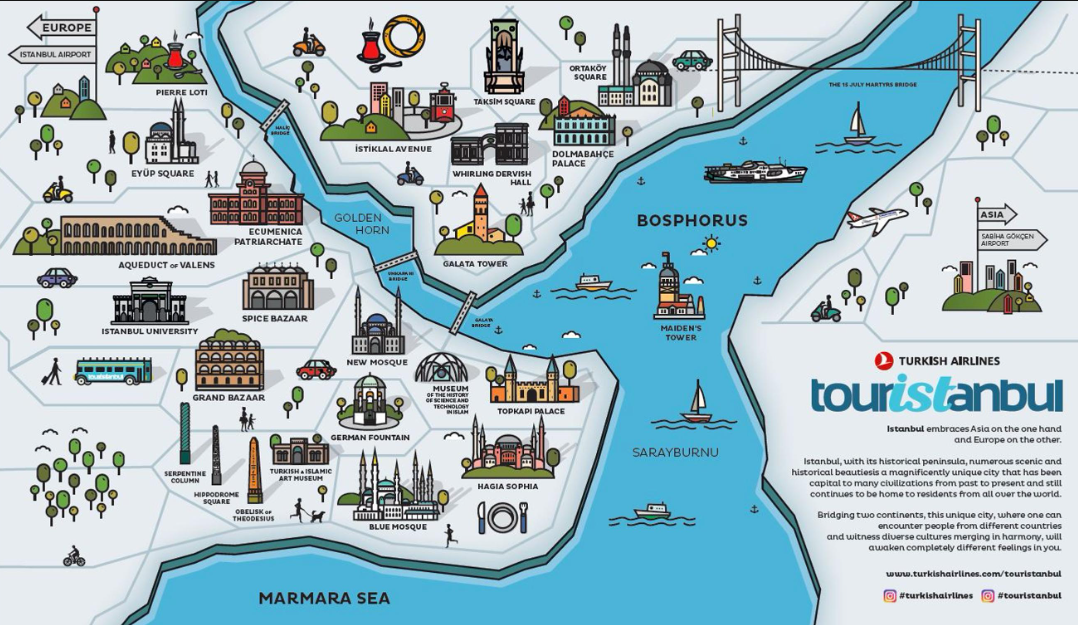
A Turkey tourist attractions map is essential for planning your trip, as it will help you navigate the country’s diverse offerings. Let’s dive into some of the must-visit locations that should be included in your itinerary.
1. Istanbul: The Vibrant City of Two Continents
Istanbul, Turkey’s largest city, is a true cultural melting pot. Straddling both Europe and Asia, Istanbul is a city of contrasts, where ancient traditions coexist with modern-day comforts. Here are some iconic spots in Istanbul:
- Hagia Sophia: A UNESCO World Heritage site, this former Greek Orthodox Christian basilica, later an Ottoman mosque, and now a museum, showcases the blending of Christian and Islamic architecture.
- Topkapi Palace: This opulent palace was home to Ottoman sultans and offers a glimpse into the grandeur of the empire.
- Blue Mosque: Known for its stunning blue tiles, this mosque is an architectural marvel and one of the most famous landmarks in Istanbul.
Tip for Travelers:
Be sure to visit the Grand Bazaar in Istanbul, one of the largest and oldest covered markets in the world, where you can buy Turkish rugs, spices, and other unique souvenirs.
2. Pamukkale: The Cotton Castle of Turkey
Pamukkale, meaning “cotton castle” in Turkish, is a natural wonder known for its white terraces formed by calcium deposits from hot springs. Visitors can take a dip in these thermal pools while marveling at the surrounding beauty. Located in the Denizli Province, Pamukkale is also home to the ancient ruins of Hierapolis, a UNESCO World Heritage site.
- Pamukkale Hot Springs: The warm, mineral-rich waters are said to have therapeutic properties.
- Hierapolis Ancient City: Explore the well-preserved ruins of this ancient Roman spa city.
Did You Know?
Pamukkale’s terraces have been used as a thermal bath for over 2,000 years, attracting both tourists and health seekers.
3. Cappadocia: The Land of Fairy Chimneys
Cappadocia is a region famous for its unique geological formations, ancient cave dwellings, and hot air balloon rides. The landscape is dotted with fairy chimneys—tall, thin spires of rock created by erosion. The region also offers a chance to explore ancient rock-cut churches and monasteries.
- Göreme National Park: A UNESCO World Heritage site, this park is home to stunning rock formations and cave churches.
- Hot Air Balloon Ride: A must-do experience, giving you panoramic views of Cappadocia’s surreal landscape.
Tip for Travelers:
For the best experience, book a hot air balloon ride early in the morning to see the stunning sunrise over the fairy chimneys.
Turkey Tourist Attractions: A Perfect Blend of Culture and Nature
The blend of Turkey’s tourist attractions and its rich cultural heritage makes it a unique and fascinating destination. Whether exploring ancient ruins, relaxing on pristine beaches, or enjoying the vibrant atmosphere of cities like Istanbul, Turkey offers something for everyone.
In the following sections, we will continue to explore more must-visit spots on the Turkey tourist attractions map, focusing on hidden gems, adventure destinations, and cultural experiences.
Interesting Tip:
If you’re traveling to Turkey, always have a local SIM card or a good map of Turkey tourist attractions to make navigation easier. Apps like Google Maps or TripAdvisor also provide excellent insights into popular places, opening hours, and user reviews.
Turkey offers a wealth of destination varieties to travelers: from dome-and-minaret filled skyline of Istanbul to Roman ruins along the western and southern coasts, from heavily indented coastline against a mountainous backdrop of Lycia and wide and sunny beaches of Pamphylia to cold and snowy mountains of the East, from crazy “foam parties” of Bodrum to Middle Eastern-flavoured cities of Southeastern Anatolia, from verdant misty mountains of Eastern Black Sea to wide steppe landscapes of Central Anatolia, there’s something for everyone’s taste—whether they be traveling on an extreme budget by hitchhiking or by a multi-million yacht.
Turkey Regions
Turkey regions – Color-coded map:
- Aegean Turkey
Greek and Roman ruins between the azure sea on one side and silvery olive groves on the opposite - Black Sea Turkey
Heavily forested mountains offering great outdoor sports like trekking and rafting - Central Anatolia
Tree-poor central steppes with the capital, Hittite and Phrygian ruins, and moon-like Cappadocia - Eastern Anatolia
High and mountainous eastern spare harsh winters. Historically inhabited by Armenians. - Marmara Region
The most urbanized region with Byzantine and Ottoman monuments in a number of the country’s greatest cities - Mediterranean Turkey
Mountains clad with pine woods ascending right from the heavily-indented coastline of the crystal clear sea - Southeastern Anatolia
Semi-desert/mountainous a part of the country. Primarily Kurdish inhabited.
Cities at Turkey
- 1 Ankara — the capital of Turkey and its second-largest city
- 2 Antalya — the fastest growing city, hub to an array of beach resorts
- 3 Bodrum — a classy coastal town in Southern Aegean which turns into a crowded city in the season when it is a playground for Turkish and international holidaymakers alike, featuring a citadel, Roman ruins, trendy clubs, and a variety of villages surrounding the peninsula each with a special character from classy to rustic
- 4 Edirne — the second capital of the Ottoman Empire
- 5 Istanbul — Turkey’s largest city, the previous capital of both the Ottoman and Byzantine Empires, and therefore the only major city within the world to straddle two continents
- 6 Izmir — Turkey’s third-largest city, hub to an array of beach resorts
- 7 Konya — a quite large city that’s the heartland of mystic Sufi order, the location of Rumi’s tomb, and with some elegant Seljuq architecture, all surrounded by vast steppes
- 8 Trabzon — the wonderful Sumela Monastery is simply outside the town and it’s an excellent gateway to exploring the Turkish Northeast
- 9 Urfa — a city with beautiful architecture and very friendly locals at the gates of the Eastern World; where Turkish, Kurdish, Arabic, and Assyrian cultures mingle
Other destinations in Turkey
Over the turquoise waters in Ölüdeniz
- 1 Ani — impressive ruins of the medieval Armenian capital within the Far East of the country; referred to as the town of 1000 churches
- 2 Cappadocia — a neighborhood within the central highlands best known for its unique moon-like landscape (the “fairy chimneys”), underground cities, cave churches, and houses carved within the rocks
- 3 Ephesus — well-preserved ruins of the Roman city on the West Coast
- 4 Gallipoli — site of 1915 Anzac landing and lots of WWI memorials
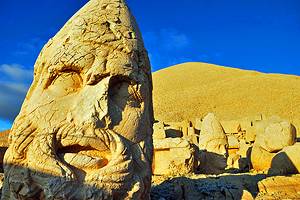
- 5 Mount Nemrut — a UNESCO World Heritage site with head statues dedicated to ancient gods on its summit
- 6 Ölüdeniz — incomparable postcard great thing about the “Blue Lagoon”, perhaps the foremost famous beach of Turkey which you’ll see on any tourism brochure
- 7 Pamukkale — “the Cotton Castle”, white world of travertines surrounding cascading shallow pools crammed with thermal waters
- 8 Sümela Sumela Monastery on Wikipedia — stunning monastery on the cliffs of a mountain, a must-see on any trip to the northeast coast
- 9 Uludağ — a park featuring school textbook belts of various sorts of forests varying with altitude, and therefore the major winter sports resort of the country.
As a general rule, most museums and sites of ancient cities in Turkey are closed on Mondays (even Hagia Sophia). The Turkish government offers a museum pass for several sights and museums in Turkey for 375 TL. inspect what’s included, and pip out if it is sensible for you. Numerous sights can still be seen free of charge though.
Turkey’s famous Göbekli Tepe.
At the crossroads of civilizations, all parts of Turkey are filled with a mindblowing number of ancient ruins. Göbekli Tepe, an ancient archaeological site near the town of Şanlıurfa in Southeastern Anatolia, Turkey.
Hittites, the primary indigenous folks that rose to found a state in Anatolia—although Çatalhöyük and Göbekli Tepe preceding them, the earliest settlement and earliest temple ever found to the date in Turkey—left the proof of their existence at the ruins of Hattuşaş, their capital. The Hittites spoke an Indoeuropean language (the oldest one attested in writing) and were contemporaries of the “New Kingdom” of Ancient Egypt, engaged in extensive correspondence and diplomacy with the eastern Mediterranean world.
Ancient Greeks and closely following Romans left their mark mostly in Aegean and Mediterranean Regions, leaving the marble ruins of many cities, temples, and monuments. Some are largely restored to their former glory, like Ephesus also as numerous others along the Aegean coast which are on the checklist of most travelers to Turkey, alongside some more obscure ones off the beaten path like Aphrodisias near Denizli, and Aizanoi near Kütahya.
In the meantime, other indigenous peoples, like Lycians, were carving beautiful tombs—many of which are fairly well preserved and may be seen all around Lycia—for their dearly departed ones onto the rocky hillsides.
Legendary Troy stands out as an example of various civilizations literally living on the highest of every other. While what’s visible today is clearly Hellenistic, the place has its roots as Hittite Wilusa, and later re-built repeatedly over by Ancient Greeks.
Perhaps the foremost unique “architectural” heritage within the country, a number of the Cappadocian cave houses and churches carved into “fairy chimneys” and underground cities (in a literal sense!) go back to early Christians hiding from persecution.
Successors of Romans, the Byzantines, broke new ground with more ambitious projects, culminating in grand Hagia Sophia of Istanbul, inbuilt 537, and which had the excellence of being the most important cathedral within the world for nearly a thousand years. While a stray monastery or two dating back to the age are often found in almost any part of the country, most of the Byzantine heritage intact today is found within the Marmara Region, especially in Istanbul, and within the area around Trabzon within the far northeast, which was the domain of the Empire of Trebizond, a rump Byzantine state that survived the autumn of Constantinople for a few decades.
Seljuk ruins protected by a contemporary roof construction in Konya
Seljuks, the primary ever Turkic state to be founded in Asia Minor, built most of their monuments—which incorporates large majestic portals and heavily delicate stonework, like some landmarks in parts of Asia—in major centers of the time in Eastern and Central Anatolia, especially in Konya, their capital.
Ottomans, who had considered themselves as a Balkan country until their demise, built most of their landmarks in the Balkans and therefore the natural extension of Balkans within today’s Turkey—Marmara Region—just like the Byzantines, whom the Ottomans inspired in numerous ways. Most of the sooner Ottoman monuments were inbuilt Bursa, which have little Byzantine and comparatively large Seljuk influences, and later, when the dynasty moved to Europe, in Edirne, a number of the main landmarks of which exhibit some quite “transitional” and fairly experimental style. It wasn’t until the autumn of Constantinople that the Ottomans adopted Byzantine architecture almost full scale with some adjustments. However, the Ottoman imperial architecture possibly reached its zenith not in Istanbul, but in Edirne—in the shape of Selimiye Mosque, a piece of Sinan, the good Ottoman architecture of the 16th century.
The 19th century brought back the Greek and Roman taste of architectural styles, so there was an enormous explosion of neo-classical architecture, the maximum amount fashionable in Turkey as within much of the remainder of the planet at that point. Galata side of Istanbul, Izmir (though unfortunately most of which was lost to the large fire of 1922), and various towns along the coasts, one most prominent and well-preserved example being Ayvalık, quickly crammed with elegant neo-classical buildings.
At an equivalent time, people in additional inland locations were favoring pleasant, more traditional, and fewer pretentious half-timbered whitewashed houses, which form picturesque towns like Safranbolu, Beypazarı, and Şirince in northern, central, and western a part of the country respectively. it had been also this point beautiful and impressive wooden mansions of Istanbul’s seaside neighborhoods and islands were built. Other contemporary trends of the age, like Baroque and Rococo, didn’t make many inroads in Turkey, although there have been some experiments of mixing them into Islamic architecture, as are often seen at Ortaköy Mosque on the banks of Bosphorus alongside some others.
As the landscapes change the more east you go, so does the architectural heritage. The remote valleys and hilltops of Eastern Karadeniz and Eastern Anatolia are dotted with numerous medieval Georgian and Armenian churches and castles—some of which are nicely well preserved but not all were that lucky. Armenian cathedral on Akdamar Island of Lake Van and medieval Ani are two that lay somewhere on the midway between perfectly preserved and undergone total destruction, but both are absolutely must-sees if you’ve made your way that east. For a change, Southeastern Anatolia features more Middle East-influenced architecture, with arched courtyards and heavy usage of yellow stones with highly exquisite masonry. it is best seen in Urfa, and particularly in Mardin and nearby Midyat.
Being on the crossroads of civilizations more often than not also means being the battleground of civilizations. So it’s no wonder why numerous castles and citadels dot the landscape, both in towns and countryside, and both on the coasts and inland. Most of the castles built during different stages of history are today the main attractions of the towns they’re standing on.
The 20th century wasn’t kind on Turkish cities. thanks to the pressure caused by high rates of immigration from rural to urban areas, many historical neighborhoods in cities were knocked down in favor of soulless (and usually, drab ugly) apartment blocks, and outskirts of major cities transformed to shantytowns. there’s not really much of a gem within the name of recent architecture in Turkey. Steel-and-glass skyscrapers, on the opposite hand, are now slowly and sparsely being erected in major cities, one example where they concentrate very much like to make a skyline view being the downtown of Istanbul, although hardly impressive compared with major metropolises around the world known for his or her skyscraper filled skylines.
Read more: https://en.wikivoyage.org/wiki/Turkey

Map Of Turkey Tourist Attractions Google Search Turkey Turkey
FAQS Turkey Tourist Attractions Map
What is the foremost beautiful part of Turkey?
The Fairy Chimneys of Cappadocia. High on the Anatolian plateau, the curious landscapes of Cappadocia resemble a phantasy world.
- The pools of Pamukkale.
- Blue Lagoon, Olüdeniz.
- Gümüşlük, Bodrum.
- The domes of Istanbul.
- Patara.
- Kaş
- Ephesus.
What is the nicest place in Turkey?
Best places to go to in Turkey:
- Marmaris. Marmaris is one of the pearls of the Turkish Riviera.
- Bodrum. Located within the southwest of Turkey, bordered by the Aegean, Bodrum may be a perfect destination for beach lovers, gastronomy, skin diving, and wine.
- Istanbul.
- Lycian Rock Tombs.
- Ankara.
- Kas.
- Antalya.
- Izmir.
Where do most tourists come from in Turkey?
The most popular destinations within Turkey are mainly the main cities of Istanbul and Antalya, which are rich in history, also because of the coastal regions of the Aegean and therefore the Mediterranean. Most tourists come from Russia and Germany.
What is Turkey famous for?
What is Turkey famous for?
- Istanbul. Most tourists visit Turkey for Istanbul.
- Hagia Sophia. Considered together of the world’s greatest structures, Hagia Sophia may be a cultural gem.
- Bosphorus Strait.
- Grand Bazaar.
- Spice Bazaar.
- Galata Bridge.
- Ephesus.
- Pamukkale.
Which month is that the best to go to Turkey?
April, May, September, and October are pleasantly warm, with temperatures of 20°C to 30°C, so are typically the simplest times to go to Turkey’s grand array of ancient sites. The summer months (June through to September) are extremely popular, with temperatures reaching the mid-thirties on the south coast.
What do you have to not miss in Turkey?
8 belongings you don’t need To Miss In Turkey
- Paraglide above Ölüdeniz.
- Indulge in one among the World’s Finest Cuisines.
- Visit Ephesus.
- Try the National Drink- Ayran.
- Spot Sea Turtles in Dalyan.
- Visit Istanbul.
- Get Your Caffeine Fix.
- Drink Çay and Play Tavla.
Is Turkey expensive to visit?
The average price of a 7-day trip to Turkey is $870 for a solo traveler, $1,416 for a few, and $1,054 for a family of 4. Turkey hotels range from $33 to $141 per night with a mean of $54, while most vacation rentals will cost $70 to $390 per night for the whole home.
Where should I holiday in Turkey?
The 8 best beach holidays in Turkey for 2020
- Patara. This broad strip of gently shelving white sand isn’t only Turkey’s longest beach, but also its most beautiful.
- The Bodrum Peninsula.
- Ölüdeniz.
- Kalkan.
- Antalya.
- Side.
- Alanya.
- Alaçati.
How many days does one need in Turkey?
How much time should I spend in Turkey? Although there’s plenty to try to do in Turkey to fill a whole month or more, we propose Turkey itineraries that are between five to 10 days, with a week-long holiday being the simplest for many travelers.
How much money does tourism bring back to Turkey?
Tourism Revenues in Turkey averaged 3989.02 USD Million from 1990 until 2021, reaching an all-time high of 14031 USD Million within the third quarter of 2019 and a record low of 294 USD Million within the half-moon of 1990.
What is Turkey’s main religion?
Turkey may be a secular country with a majority Muslim population. There are not any formal statistics on the population’s religious affiliation.
Is Turkey open now for tourists?
Yes, Turkey is open to tourism. As always, foreigners need a passport and a legitimate visa or a replica of an approved online eVisa to visit Turkey.
What should I buy from Turkey?
Souvenir Shopping in Turkey: 14 Things to shop for
- Turkish Carpet and Rugs. Some people buy Turkish carpets or rugs because they just like the patterns and stories of how they’re made.
- Turkish Delight.
- Turkish Tea and Glasses.
- Nargile Pipes.
- The Blue look of Turkey.
- Gold.
- Turkish Mosaic Lamps.
- Ceramic Souvenir Ideas.
Why are Turkish dramas so good?
Turkish novels have great stories centered on family, dramatic characters, unforeseen difficulties, and modern experiences that co-exist in traditional ones – all with beautiful high-quality production and lovely locations.
What was the name of Turkey in biblical times?
- New Testament
- Biblical name Mentioned in Country Name
- Assos Acts 20:13 Turkey
- Attalia Acts 14:25 Turkey
- Berea Acts 17:10-13 Greece
- Cauda Acts 27:16 Greece
What is the coldest month in Turkey?
January. Quick Climate Info:
- Hottest Month August (78 °F avg)
- Coldest Month January (43 °F avg)
- Wettest Month December (1.70″ avg)
- Windiest Month August (11 mph avg)
How does one dress in Turkey?
As for Turks, most of them are going to be wearing “smart casual” clothes: sleeved summer dresses or sleeved tops and skirts for ladies, short-sleeved shirts, and long pants for men. Footwear is often shoes or sandals.
Which is that the best area to remain in Turkey?
- Istanbul – the general Best Place to remain in Turkey.
- Izmir & the North Aegean – Best Place to remain in Turkey for Families.
- Cappadocia – Where to remain in Turkey for Couples.
- Istanbul – the good Place to remain in Turkey.
- Bodrum – Where to remain in Turkey on a Budget.
Can u drink the water in Turkey?
Yes, you’ll drink water from the taps in Turkey but we highly recommend our guests use drinking water during their stay.
What are the do’s and don’ts in Turkey?
Turkish people are welcoming, friendly, willing to supply help and have a talk. Do be courteous. Do remember ‘evet’ means ‘yes’ and ‘hayir’ means ‘no’ in Turkish. Don’t make any derogatory comments about the Turkish Flag, Turkey, or Kemal Atatürk, the Turkish Republic’s Founding Father….or actually anything Turkish.
Is Turkey safe for female Travellers?
Turkey is pretty safe, especially compared to the US. In terms of violence against women and harassment, Turkey isn’t particularly dangerous. However, it does have different gender dynamics, so do not be surprised if people are shocked that you simply, a woman, are traveling alone.
Do people speak English in Turkey?
Prevalence of English is really quite low in Turkey, with but one-fifth of the population reported as speaking English. … Recent stats indicate that around 17% of the Turkish population can speak English to some extent, though even many of this small proportion will only be ready to speak very Basic English.
How much pocket money will I want for every week in Turkey?
A vacation to Turkey for one week usually costs around TRY3,038 for one person. So, a visit to Turkey for 2 people costs around TRY6,077 for one week. a visit for 2 weeks for 2 people costs TRY12,154 in Turkey.
How much does a meal cost in Turkey?
Cost of Living in Turkey
- Restaurants Edit
- Meal, Inexpensive Restaurant 35.00TL
- Meal for two People, Mid-range Restaurant, Three-course 150.00TL
- McMeal at McDonald’s (or Equivalent Combo Meal) 30.00TL
- Domestic Beer (1-pint draught) 20.00TL
Which is best Bodrum or Antalya?
Antalya is far warmer than Bodrum thanks to its more easterly location and, as such, features a longer summer season. … during a beach comparison between Bodrum and Antalya, Antalya is that the winner. While Bodrum has several wondrous beaches nearby, Antalya has some excellent public beaches within the town.
Is Turkey good for family holidays?
Turkey is that the perfect choice for a family holiday with welcoming locals, family-friendly resorts, beaches, shopping, and an enormous choice of excursions and days out.
Where do most Brits enter Turkey?
The majority of Britons are found in Istanbul, with smaller populations scattered throughout the capital Ankara. Istanbul is usually seen as a favorite location thanks to the town being the country’s commercial capital, the presence of international schools, and better air links with the united kingdom.
15 Top Rated Tourist Attractions In Turkey Planetware
Turkey Map Tourist Attractions Travelquaz Com- Turkey Tourist Maps 796762- Middle East Tourist Attractions Israel Egypt Jordan Bahrain
References: Turkey Tourist Attractions Map
- “Cultural Heritage of Turkey: A Historical Overview.” Turkey Culture and Tourism Ministry, 2024.
- “The Best Attractions to Visit in Turkey.” Lonely Planet, 2024.
- “Pamukkale: A Geological Marvel.” UNESCO World Heritage, 2024.


